Athletics
How a false start is detected, and why the rule is written as it is
The rule rests on a claim about human reaction that is measured rather than observed, and the threshold it applies is the part most worth understanding.
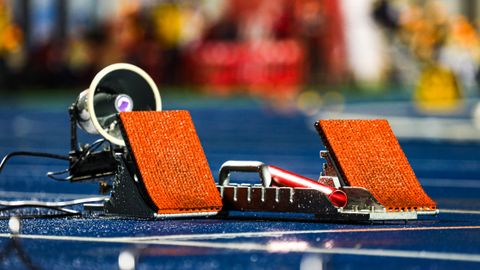
What the blocks are measuring
Starting blocks contain sensors that record the force a runner applies against the footplate throughout the entire start sequence. The system looks for the moment that force rises sharply above the resting level, which marks the beginning of the drive out. It compares that moment with the firing of the gun, producing an interval that is recorded for every runner in the race.
Nothing about this depends on an official seeing anything at all, which is precisely the point of using the system. The output is a set of intervals, and the rule then applies a published threshold to them.
The reaction threshold
A runner producing force sooner than the accepted minimum reaction interval is treated as having moved before processing the sound. The threshold is not a claim about any individual but a boundary drawn beneath the range of plausible human reaction. Anything faster is taken as anticipation rather than response, since a runner cannot react before the signal has actually been perceived.
The specific value has been debated at length, because setting it too high penalises athletes with genuinely fast reactions. Work on the question continues, and the threshold remains a policy choice informed by evidence rather than a physical constant.
Why the sanction became immediate
Earlier rules allowed a field one collective false start before disqualification, which created an incentive to break deliberately. A runner could unsettle rivals by committing the first infringement in the knowledge that the penalty fell on nobody in particular. The current approach disqualifies the individual responsible immediately, which removes that tactic from the sport entirely.
It is harsher, and it has ended races for leading athletes on a margin measured in small fractions of a second. The justification is that the alternative rewarded gamesmanship and lengthened races that a schedule could not easily absorb.
The set position and the starter
Between the set command and the gun there is a deliberate pause of variable length, controlled entirely by the starter. Variability is essential, because a fixed interval would allow runners to time the start rather than react to the signal. A runner who moves during that pause without leaving the blocks commits a different offence, usually handled by a recall and a warning.
Distinguishing an unsteady set position from an attempted start is a judgement the automated system does not attempt to make. This is the part of the start where human officiating still carries the whole decision.
What the rule cannot capture
Reaction time varies with fatigue, temperature and the acoustics of a stadium, none of which the threshold makes any allowance for. Sound reaches runners in outer lanes marginally later unless speakers are placed directly behind each set of blocks. Modern facilities address this with individual speakers, but the issue persists wherever those are absent.
A runner may also produce force through an involuntary movement that the sensors cannot distinguish from the beginning of a start. These limits are why appeals about starts turn on equipment and procedure rather than on any athlete's own account of what happened. An athlete who insists that he did not move early is not really disputing the measurement so much as the assumption on which that measurement rests.
The assumption is defensible and shared across the sport, but it remains an assumption rather than something observed in each individual case.
- The blocks measure force, not movement
- The threshold is a policy boundary, not a physical constant
- Immediate disqualification removed a deliberate tactic