Tennis
Court surfaces: what actually differs between clay, grass and hard
Surface is usually described in terms of speed, but the meaningful differences lie in friction and in what the bounce does to the ball afterwards.
Speed is the wrong single variable
A surface is commonly called fast or slow, but that single word compresses at least two separate physical effects into one description. The first is how much horizontal speed the ball loses in the bounce, which depends on the friction between ball and surface. The second is how high the ball rises afterwards, which depends on how much the surface and the ball deform and then recover.
A court can be slow and low, or fast and high, and each combination produces a recognisably different kind of rally. Describing courts along one axis is why players and commentators so often appear to disagree about the same surface.
Clay and the loose top layer
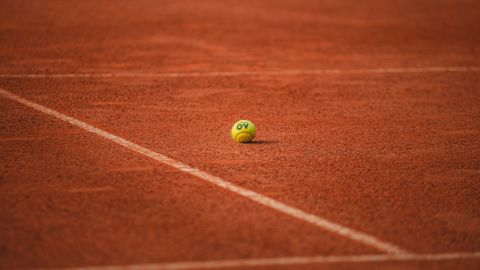
Clay courts carry a loose granular layer over a compacted base, and the ball interacts with that layer rather than with anything solid. The granules shear on impact, removing horizontal speed and converting more of the ball's energy into vertical rebound. The result is a slower and higher bounce that gives the returning player time and rewards heavy topspin considerably.
The loose layer also permits sliding, which changes movement fundamentally by letting a player decelerate into a shot rather than before it. Because the layer is loose it changes across a match and across a day, which is why the same court plays differently at different hours.
Grass and the low skid
Grass sits on soil and the ball contacts both blade and ground, producing lower friction and considerably less loss of speed. The bounce stays low, which shortens reaction time and favours players who take the ball early and drive through it. Grass is also uneven in a way hard courts are not, so bounces vary unpredictably and simpler technique tends to be rewarded.
The surface wears visibly across an event, with the areas behind the baseline losing cover first and playing differently by the later rounds. That wear is itself part of the competitive test, since the court a player faces late is not the one prepared at the start.
Hard courts and their range
Hard courts are an acrylic layer laid over concrete or asphalt, and their behaviour is set by the texture of that coating. Adding more granular material to the coating raises friction and slows the surface, so two hard courts can play very differently indeed. This tunability is why hard courts host such a range of events and why they resist any single description.
The rigid base returns energy efficiently, producing a bounce that is consistent and true from one point to the next. That consistency is what makes hard courts a neutral test, and it is also what makes them demanding on the body.
How surface shapes the demands on a player
Longer rallies on slower surfaces raise the aerobic demand and shift the balance towards endurance and patience rather than raw power. Faster surfaces compress points, which raises the value of the serve and of whatever shot follows it. Movement differs as much as ball-striking, since sliding, planting and recovering are each specific to a surface.
Temperature and altitude interact with all of this by changing the ball itself, which becomes livelier in warm and thin air. A player described as a surface specialist is usually somebody whose movement, rather than whose technique, suits one set of conditions.
- Speed compresses at least two separate physical effects into one word
- Clay changes during a match because its top layer is loose
- A surface specialist is usually defined by movement rather than technique