Wimbledon
How a grass court is prepared, and why it changes across a fortnight
The court a player meets in the second week is not the one prepared for the first, and the wear pattern is predictable enough to plan around.
The soil beneath the grass
A grass court is built over a heavily compacted soil base, and the hardness of that base determines the bounce far more than the grass does. Rolling compacts the surface across a long period, producing a base firm enough to give a true and consistent rebound. A soft base produces low and dead bounces with unpredictable behaviour, which is the usual failure mode of an under-prepared court.
The grass itself contributes friction and protects the surface, but the ball is effectively bouncing off the ground beneath it. This is why courts play faster and lower when dry, since moisture softens the base and absorbs energy from the bounce.
Cutting height and species
The grass is cut extremely short, and the height is held constant so that playing characteristics do not drift across an event. Hard-wearing rye grasses are used because they tolerate short cutting and recover more readily than the finer ornamental varieties. Species choice has changed over time, and different mixtures produce measurably different durability and ball behaviour.
Any change to the mixture alters how a court plays, which is why such decisions are made cautiously and reviewed across years. Consistency between courts at a single venue matters quite as much as the absolute characteristics of any one of them.
Where the court wears
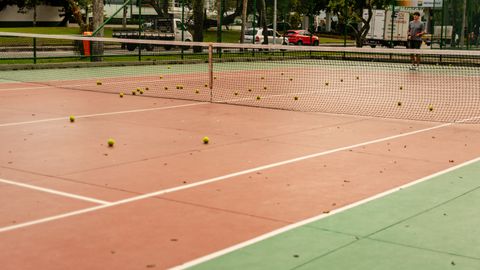
Wear concentrates in the areas behind the baseline and around the service line, which are where players stand and push off repeatedly. The centre of the baseline goes first, and by the later stages the cover there is thin or has disappeared entirely. Bare soil plays differently from grass, generally with a truer but slightly lower bounce and rather more grip underfoot.
The area near the net wears far less, since fewer players spend sustained periods there in the modern game. That asymmetry means a court effectively becomes two surfaces, one worn through and one largely intact.
How players adjust to the wear
A worn baseline offers more reliable footing, which paradoxically makes late-tournament courts easier to move on for baseline players. The bounce becomes more predictable as the grass thins, which reduces the advantage held by players who thrive on irregularity. Serving into worn areas produces slightly different behaviour, which is a small factor but one that experienced players read and use.
The change is gradual rather than sudden, so a player progressing through an event experiences it as a slow drift in conditions. It is also why comparisons between early-round and late-round play on grass have to account for the surface itself.
Weather and the covers
Rain saturates the base and makes play unsafe long before the surface looks unplayable, which is why covers go on so quickly. Removing water is only part of the task, since the base must then dry sufficiently to return to its prepared firmness. Ground staff use covers, blowers and time, and the last of those is the constraint that cannot be shortened by any equipment.
Humidity slows drying and also affects the ball, which absorbs moisture and travels less freely through heavy air. These interactions are why a damp day changes the character of grass-court tennis far more than it changes play on other surfaces, where the ground beneath is largely indifferent to the weather above it.
- The ball bounces off the compacted base, not the grass
- Wear concentrates where players push off repeatedly
- A worn baseline is more predictable, not less