Basketball
Goaltending and basket interference, explained
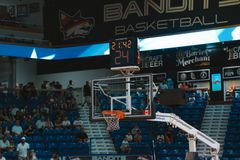
Two rules govern what may be done to a ball near the basket, and both exist because height would otherwise make defence trivially easy.
Why the rules exist
A sufficiently tall player standing beside the basket could simply pluck every shot out of the air as it descended towards the rim. That would make shooting pointless against enough height, which is a straightforward failure of the contest the sport is trying to stage. The rules therefore protect the ball once a shot has begun its descent or has reached the space immediately above the rim.
They are a rare instance of a rule introduced specifically to neutralise a physical advantage rather than to penalise any particular action. Everything technical about them follows from having to define exactly when that protection begins and when it ends.
Goaltending on the way down
Goaltending occurs when a player touches a shot that is on its downward flight and still has a realistic chance of entering the basket. The downward requirement is what distinguishes a legal block from an illegal one, since a shot still rising has not yet acquired its protection. The shot must also be above the level of the rim, so a flat trajectory can legitimately be blocked at any point along it.
When goaltending is called against the defence, the basket is awarded exactly as though the shot had been made. When an attacking player commits the same offence, the basket is disallowed and possession passes to the opposing team.
Basket interference and the cylinder
Basket interference concerns the ball once it is on, in, or directly above the rim, an area treated as an imaginary cylinder. Touching the ball or the rim while the ball occupies that space is prohibited regardless of the direction the ball happened to be travelling. Reaching up through the basket from beneath is also prohibited, which prevents a defender from deflecting a ball already dropping through.
A player may touch the ball once it has clearly left the cylinder and has no further chance of entering the basket. These definitions are geometric rather than concerned with intent, which makes them enforceable but also makes the marginal calls extremely hard.
Where the rule sets differ
Rule sets disagree over whether the ball may be played once it has struck the rim and is bouncing above it. One approach treats the ball as live at that moment, allowing both teams to compete for it directly off the rim. The other maintains the protection until the ball has left the cylinder entirely, which favours the team that took the shot.
Rebounding technique differs accordingly, and players moving between competitions have to retime a jump they have been making for years. It is a good example of two defensible answers to the same question producing two visibly different versions of a game.
Officiating and replay
These are among the hardest calls to make in real time, because the judgement concerns a ball moving quickly through a very small space. The official has to determine the direction of flight, the height relative to the rim, and whether the shot retained a realistic chance. Replay review is available in many competitions specifically for these situations, which is itself an acknowledgement of the difficulty involved.
Review is generally restricted to defined moments rather than being available on request, so that the game is not repeatedly stopped. The rules remain among the most misunderstood by spectators, largely because the cylinder is invisible and the flight is extremely quick.
- These rules neutralise a physical advantage rather than punish an action
- The cylinder is geometric, which makes marginal calls very hard
- Rule sets disagree about the ball once it strikes the rim